Waiting Room TV for Doctors: Licensing, Ads and Privacy
Putting a TV in a waiting room takes an hour. The real questions come afterwards: may the practice simply show live television? What does GEMA, Germany's music rights society, charge? Does the extra screen add to the broadcasting fee? May patient names appear on the display? And how much advertising do the professional code and the German Therapeutic Products Advertising Act (HWG) allow?
This article sorts out the legal questions around waiting room TV for doctors in Germany. For content ideas, hardware and costs, see our waiting room TV guide.
Please note: This article is a general overview (as of November 2026) of the legal situation in Germany and is not legal advice. The binding rules are those of your regional medical association (Landesärztekammer). For specific questions, ask your medical association, your Kassenärztliche Vereinigung or a lawyer specialising in medical law.
The key decision: live TV or your own content?
Almost every legal question depends on what runs on the screen. Broadly, there are three options:
Live TV or radio: this raises copyright questions, meaning GEMA, plus the broadcasting fee.
Streaming services, broadcaster libraries, video platforms: the provider's terms of use decide.
Your own content: slides with practice information, your own photos, silent videos. You are responsible for image rights, data protection and advertising rules, but you also control everything.
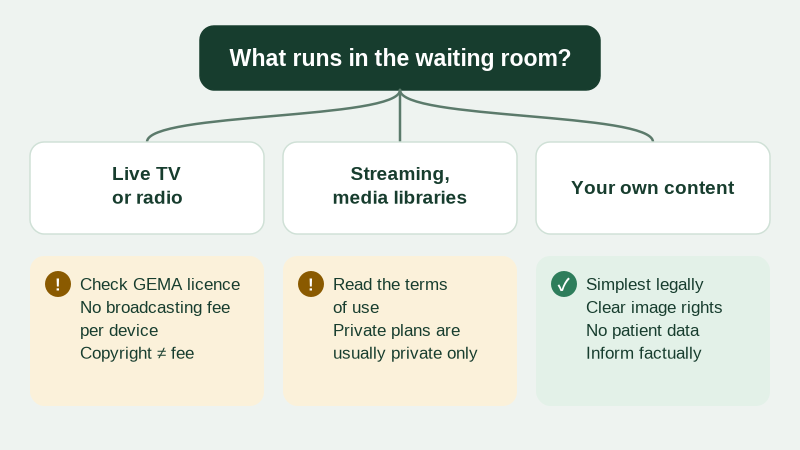
The third option is the easiest to keep compliant and also suits a calm waiting room best. The other two aren't forbidden, but they need to be cleared deliberately.
Live TV in the waiting room: GEMA and the broadcasting fee
GEMA: radio and TV are treated differently
In 2012 the Court of Justice of the EU ruled that background music in a dental practice is generally not a "communication to the public" (CJEU, C-135/10). Germany's Federal Court of Justice followed in 2015: radio music in a dental waiting room is generally not subject to royalties (BGH, judgment of 18 June 2015, I ZR 14/14, in German).
Television is a different matter. In 2016 the CJEU ruled that TV sets in the waiting and training rooms of a rehabilitation centre do constitute a communication to the public (CJEU, C-117/15 "Reha Training"). The court saw the patients as a "new public" and the TV offer as an extra service that makes the facility more attractive.
How far this applies to an individual practice depends on the case, for example on its size, patient numbers and type of facility. GEMA, at any rate, lists doctors' practices explicitly in its 2026 tariff overview (in German). For TV playback it states EUR 25.93 net per set per month (monthly contract) or EUR 259.41 net on an annual contract, plus 7 percent VAT. If you want to show live TV, clear it with GEMA in advance rather than waiting for a back-payment claim.
Broadcasting fee: no extra charge per TV
The German broadcasting fee (Rundfunkbeitrag) for businesses and practices depends on premises and number of employees, regardless of whether you own reception devices (in German). An extra TV in the waiting room therefore doesn't add to the fee. According to the collection service, premises with up to eight employees pay a third of the fee, EUR 6.12 per month; with nine to 19 employees it is EUR 18.36.
Note that the broadcasting fee and GEMA are two separate systems. The fee funds public broadcasting; it does not cover copyright for playback in your practice.
Streaming and broadcaster libraries: personal means personal
Running a personal streaming subscription in the waiting room is tempting, but usually not allowed. Netflix, for example, permits use only for personal, non-commercial purposes under its terms of use and explicitly excludes commercial purposes and public performances. Other services may have similar or different rules, so check the terms of the specific provider before you use it. If there is no explicit permission for business use, leave it.
Your own content: the simplest route legally
With your own silent slides you sidestep GEMA questions about TV and music and don't depend on any streaming terms. There are still a few rules.
Images, graphics and videos: clear the rights
You need usage rights for every image, graphic and video. That applies to pictures from an image search just as much as to material someone sends you "free to use". Licensed stock photos, your own pictures or templates from your signage provider are the safe choice. If a video contains music, the music rights for playback have to be cleared too. In a waiting room, most things work better without sound anyway.
Photos of your team: only with consent
A team photo makes the waiting room feel more personal. Under Section 22 of the German Art Copyright Act (KUG), however, portraits may only be displayed publicly with the consent of the person shown. Get written consent from your staff, point out that they can withdraw it, and remove photos from the playlist if someone withdraws consent or leaves the practice.
Data protection: no patient data on screen
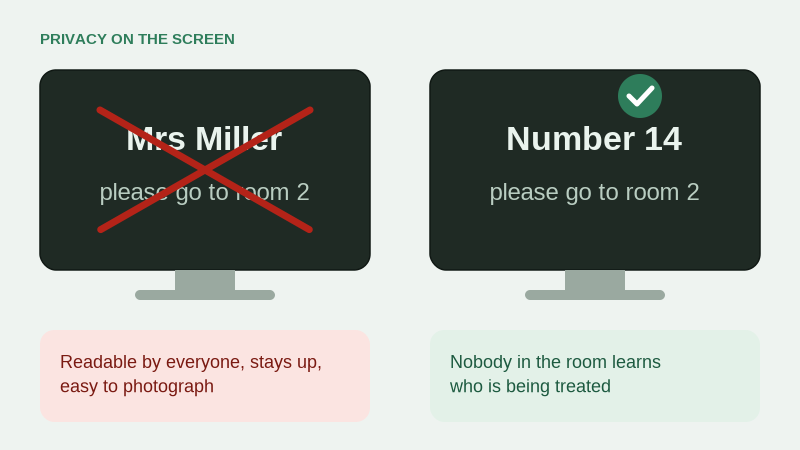
Under Art. 9 GDPR, health data is a special category of personal data. On top of that comes medical confidentiality (Section 203 German Criminal Code), which, in the widely held view, already covers the fact that someone is a patient at your practice. For waiting room TV this means one simple rule: names, appointments, diagnoses or treatments don't belong on a screen everyone can see.
Calling patients: by voice yes, on the display better not
According to a data protection FAQ from the German GP association (in German), calling patients by name out loud is generally permitted; if someone objects, you have to respect that. A screen is different from a spoken call, though: the name stays there longer, everyone can read it and it can be photographed. If you want to call patients via a display, use anonymous identifiers such as queue numbers.
Check your setup and your provider
A dedicated player, not the practice PC: if the screen is connected via HDMI to a computer running practice management software, one wrong window or notification is enough to show patient data in the waiting room. A separate player keeps the two apart.
Data processing agreement: even if the screen only shows general information, the software processes data, such as your team's logins. Ask where the data is stored and sign a data processing agreement under Art. 28 GDPR.
No cameras: waiting room TV needs neither cameras nor audience measurement.
Advertising in the waiting room: what the professional code and HWG allow
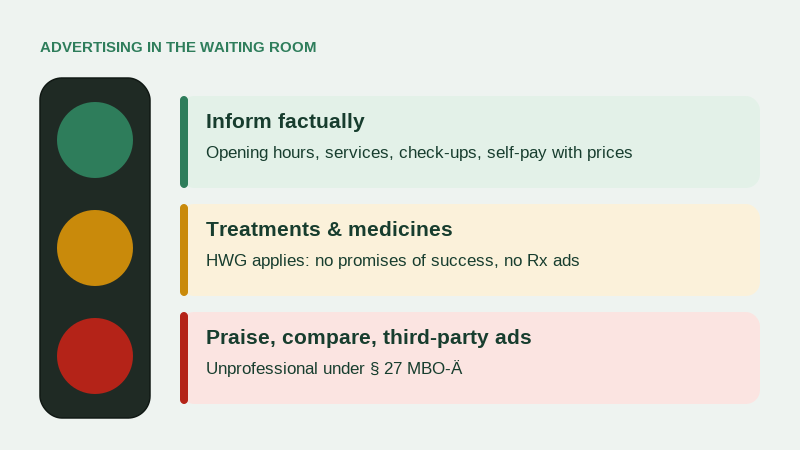
Factual information is allowed
The Model Professional Code for physicians (MBO-Ä, in German) allows "factual, profession-related information" in Section 27(2). Under Section 27(3), advertising that is contrary to professional standards is prohibited, in particular advertising that is promotional, misleading or comparative. The MBO-Ä is a model; it takes legal effect through the professional code of your regional medical association, whose wording may differ in detail.
In practice: opening hours, range of services, screening, vaccination reminders or self-pay services with transparent prices are fine. Superlatives such as "the best treatment in town" or comparisons with other practices don't belong on the screen.
HWG: take care with treatments and medicines
As soon as medicines, procedures or treatments are involved, the HWG applies as well. These points matter most in a waiting room:
No promises of success: under Section 3 HWG, advertising is misleading if it falsely suggests that success can be expected with certainty.
No advertising for prescription-only medicines: under Section 10 HWG it is only allowed towards healthcare professionals, and patients in the waiting room are not.
No before-and-after pictures for cosmetic surgery: for cosmetic surgical procedures without medical necessity, Section 11 HWG prohibits before-and-after comparisons.
Careful with testimonials and case histories: Section 11 HWG prohibits letters of thanks, recommendations and case histories if they are used in an abusive, repulsive or misleading way. Advertising aimed mainly at children under 14 is also prohibited.
Third-party ads and sponsored practice TV
One point that is often overlooked: under Section 27(3) MBO-Ä, doctors may neither "initiate nor tolerate" unprofessional advertising by others, and advertising for their own or third-party commercial products in connection with their medical work is not permitted. Look closely at free, ad-funded offers that run third-party spots in your waiting room. For a practice, an ad-free plan that shows only your own content is the clean solution.
How to do this with Showcel
Showcel is built so that the simplest legal route is also the convenient one: your own content, designed and controlled by you.
Your own slides in the browser: design your content in the editor with templates, your practice colours and your own images, with no software to install.
Videos without sound: videos play muted in the player by default.
Schedules: vaccination season in autumn, holiday closures in summer: content appears when planned and disappears again.
Quick changes: short-notice updates such as changed opening hours reach the screen remotely within minutes, without anyone walking over to the TV.
Data protection: hosting in Germany, and the data processing agreement is part of the terms. Paid plans show no ads; see the current plans on our pricing page.
For an overview of all functions, see the features page; for healthcare examples, see our page for practices and clinics.
Checklist: a legal check for your waiting room TV
Once everything is ticked off, you have the usual pitfalls under control. If you are unsure about a specific case, a quick call to your medical association is worth it. For the content that actually works in a waiting room, see our waiting room TV guide.
Not legal advice: This article is general information and does not replace legal advice on your specific case. We accept no liability for errors, omissions or later changes in the law. For specific questions, ask your medical association or a lawyer specialising in medical law.